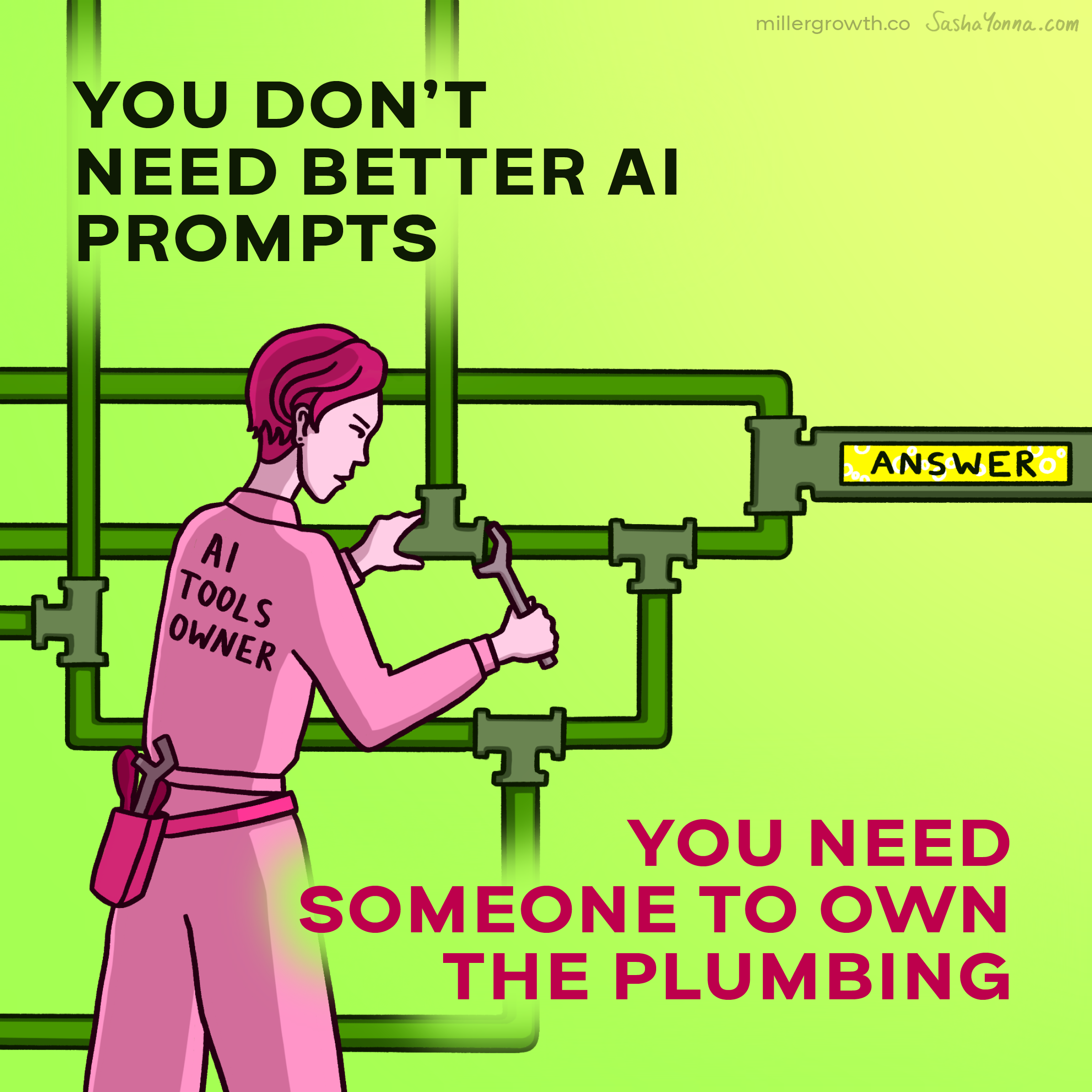
You don't need better AI prompts. You need someone to own the plumbing.
AI in GTM / RevOps
Who is it for?
Sales leaders and RevOps owners whose teams have the tools but not the results.
When to use?
When AI adoption is patchy and sellers keep reverting to manual workarounds.
2026-09-07
Most AI advice for sales teams is aimed at the individual seller: better prompts, smarter workflows, a clever system that closes more deals. It isn't wrong, but it's solving the wrong problem. The reason your team gets so little out of an expensive AI stack is that nobody owns the plumbing behind it.
"Oh yes, I'm very effective with AI. I always use ChatGPT for account research and maybe drafting emails."
I hear a version of this in almost every interview I run. It isn't a bad answer. But it’s not great - sellers should be getting much more value out of AI in today's world.
There is a huge gap between what the current tools can do and what most sales teams get out of them. The standard explanation is that sellers need to get better at using them, and LinkedIn is full of the remedy: prompt libraries, clever workflows, somebody's description of building a process in Claude that closed 50% more deals than any AE in history. Plenty of it is good content. But I'm bored of it and I don't believe it's adding value.
Some of the gap is skill, and I'm not going to pretend otherwise. But I've watched capable, motivated people give up on a tool because what they needed was three tabs and two logins away.
The bigger problem is that nobody owns the plumbing. It comes down to two things.
The tools don't talk to each other
A classic sales toolset:
Slack
Gong or Airspeed
HubSpot or Salesforce
Email
Confluence, Google Drive or SharePoint
Clay or Apollo
Lemlist, Amplemarket or Nooks
Add whatever else you like. Each one is a decent product. The problem is whether your team are actually getting the full value of the integration across the board. And the answer is probably no.
Start by looking at where your team spend their day.
Are they in Slack? Then are the call summaries from Gong or Airspeed landing in the channels they already read?
Are they in Salesforce? Then are the recordings, the email threads and the competitor mentions surfaced on the record they're looking at, or three clicks away?
When they're in Amplemarket, can they reach the account history and the competitive intel they need to write a good email?
If they have a Claude or ChatGPT account, is it connected to all of the above, so that one question searches everything?
That last one is the real test. When the answer is no, your seller is the integration layer - the one copying context out of one window and into another. Which they will probably stop doing and just go back to manual efforts.
Nobody owns the data
The second issue is the quality of the information behind your AI tools.
Calls and emails largely look after themselves. The tools capture them whether anyone thinks about it or not.
Your internal knowledge is different. Product detail, competitive intelligence, roadmap intent - that has to be written down, kept current, and kept somewhere your team can rely on at 5pm on a Thursday with an RFP due.
If this is wrong, the damage is long-term . A seller who asks the knowledge base a question and gets an answer that's out of date, or verbose, or full of clunky AI phrasing, does not ask it a second time. They go back to messaging a product manager on Slack.
Somebody has to own it
Someone needs to own the integrations. This includes sitting with individual team members and making sure everything is connected, installed and reachable from wherever that person actually works.
Someone needs to own the knowledge base. Reviewing it on a schedule, and running a feedback loop so that when a seller finds a wrong answer it gets fixed once, rather than rediscovered by the next four people. Plenty of that review can be AI-supported, but it still needs an owner.
Usually that's two people - one who knows your tools, one who knows your product. One person can do both, as long as they have the time and the skill.
Get this right and the whole organisation feels it. A seller asks one question and gets a summary of the last three calls on the account, the objection the competitor is leading with this month, and an accurate roadmap answer, without leaving the tool they were already in. Nobody else spends their week fielding questions that a maintained knowledge base should answer. And your prospect gets a straight response the same day instead of three days later.
The advantage isn't in your tech stack. It's not in hiring sellers with brilliant AI literacy. It's in a solid system that surfaces the right data in the right place at the right time.
I'm happy to talk through what that looks like in your own environment, or to share the questions I use to find where the gaps are - just let me know.
If this was useful, stay close to the thinking.
Get practical GTM insights and strategic breakdowns in your inbox. Weekly.
Related Posts
AI in GTM / RevOps
2026-09-07
You don't need better AI prompts. You need someone to own the plumbing.
Most AI advice for sales teams is aimed at the individual seller: better prompts, smarter workflows, a clever system that closes more deals. It isn't wrong, but it's solving the wrong problem. The reason your team gets so little out of an expensive AI stack is that nobody owns the plumbing behind it.
AI in GTM / RevOps, GTM & Strategy, Leadership
2026-08-03
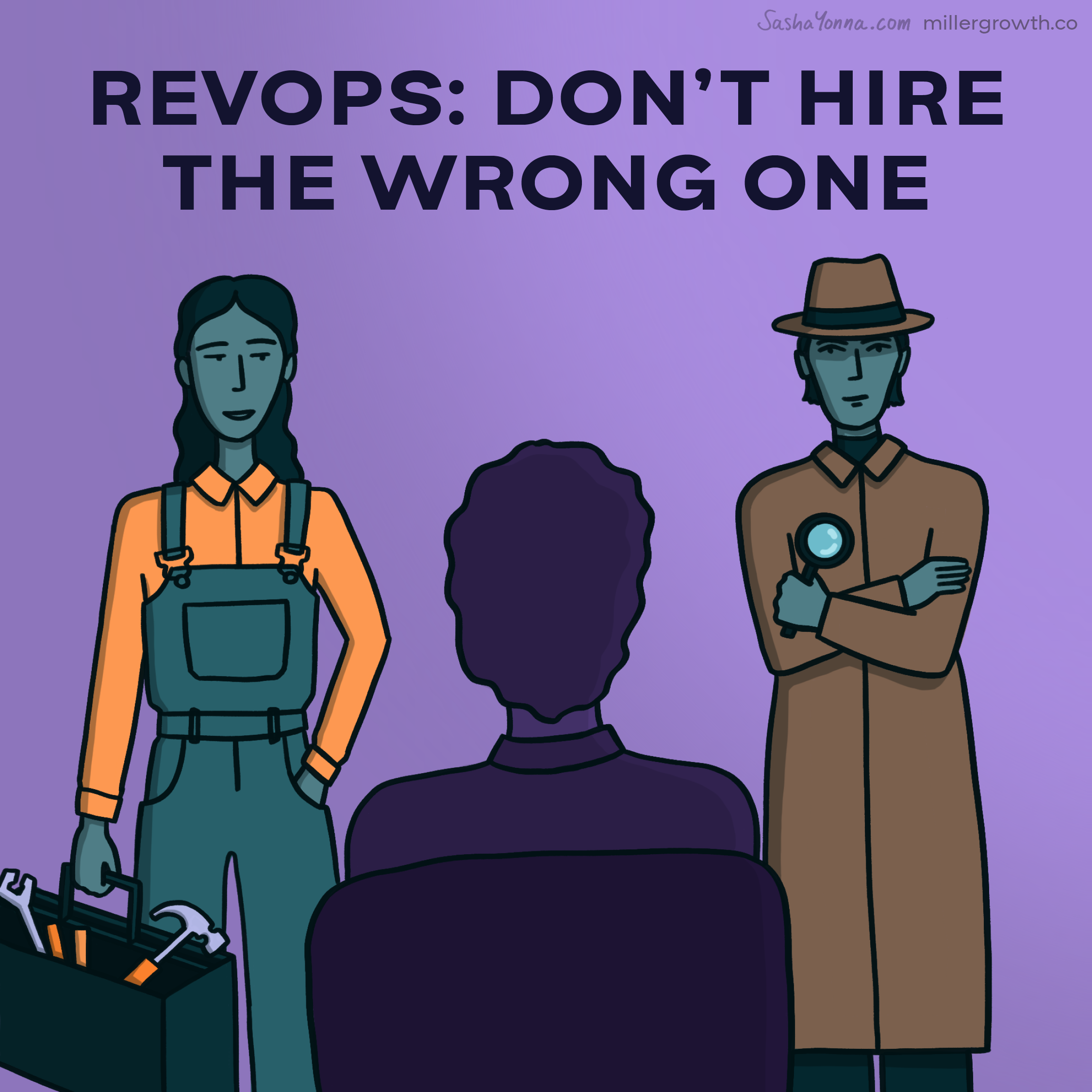
There are two RevOps hires. Most companies hire the wrong one.
Most companies hire RevOps expecting both operational rigour and commercial insight - and get neither. The two roles require different skills, and conflating them in a single job spec is one of the more expensive hiring mistakes a scaling revenue team can make.

Relevant resources
Tools and insights for improving your revenue engine
Demo Training
Coach winning demos

Discovery Training
Qualify deeper, faster
AE Toolkit
Hire top performers
See more resources →