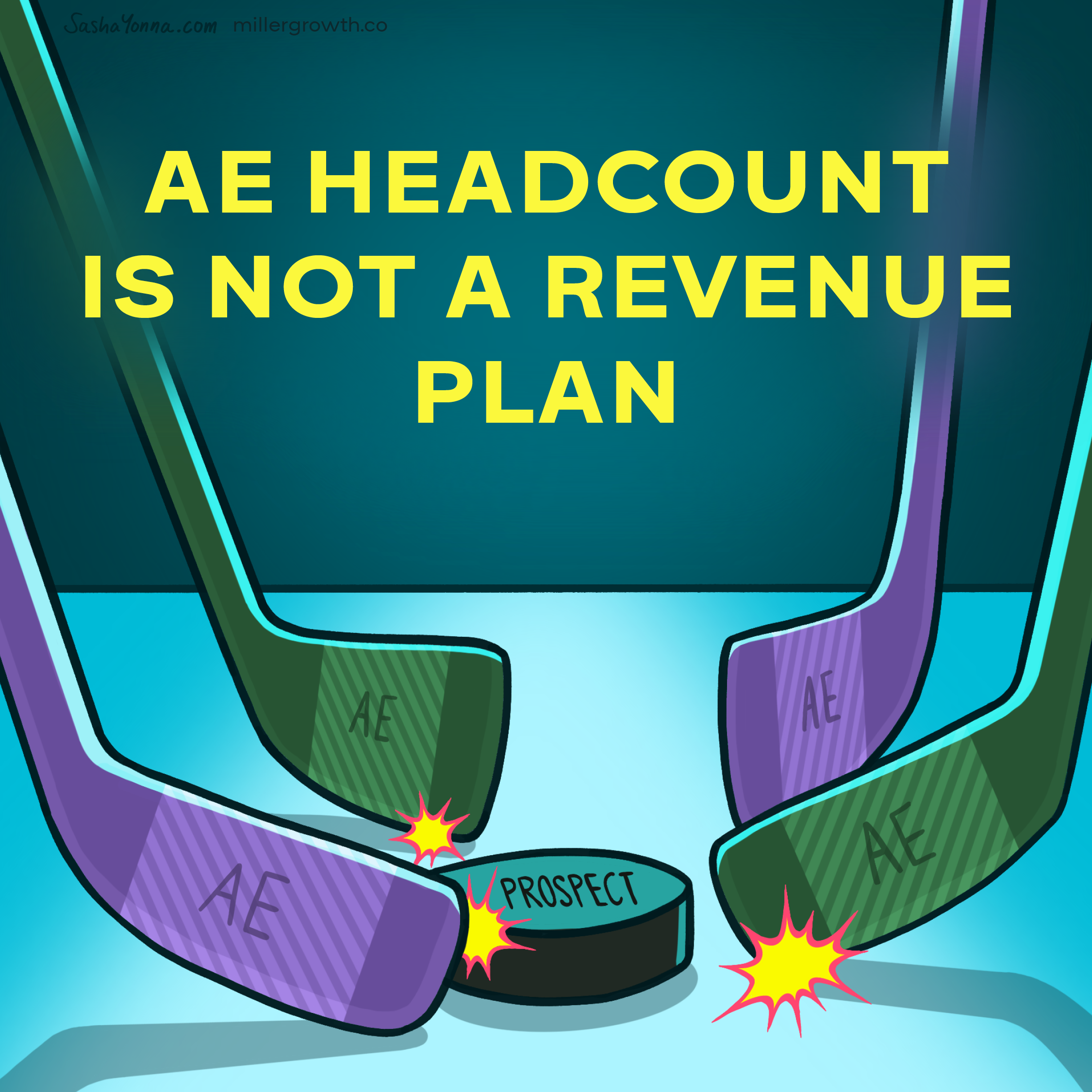
AE headcount is not a revenue plan
GTM & Strategy, Leadership
Who is it for?
CEOs, CROs, and sales leaders building or pressure-testing a headcount-driven revenue plan.
When to use?
When the revenue plan is built around AE headcount but the underlying pipeline, hiring, and ramp assumptions haven't been stress-tested.
2026-07-20
Starting with the number of AEs needed when building your revenue plan assumes pipeline, hiring speed, ramp time, and operational readiness will all hold. Most of the time, at least one of them doesn't - and the cost of being wrong is significant.
I have lost count of the number of revenue plans that I have seen which start with:
Number of AEs
Quota per head
Expected rate of quota success
Revenue output
It feels great.
20 AEs each delivering £800k. Assume we are 80% successful.
Boom. We have hit our £13m ARR target.
But… this hides a number of massive assumptions.
1️⃣ Pipeline
Do you have enough pipeline to feed these AEs?
If you have a reliable engine that is delivering opportunities, and you have proven that investing more in that engine delivers more revenue, hurrah.
But still be careful. If you are massively scaling your sales team, do you know for sure that you can massively scale this same engine? Or are you going to bump up against market size constraints, channel saturation, declining conversion rates or some other challenge?
2️⃣ AE self-sourcing
The answer “they will build their own pipeline” is dangerously attractive.
There are businesses where AEs can and should build a meaningful amount of their own pipeline, particularly through targeted outbound, referrals, previous relationships and intelligent account work.
But it is rare for AEs to bring the majority of their own pipeline. So you need the engine working elsewhere as well.
If they are going to build their own pipeline, do you have proven evidence that this works? Have your existing AEs done it? In this market? To this ICP? At this deal size? With this proposition?
And you now need to hire AEs who are good at creating pipeline as well as managing deals - not everybody is.
3️⃣ Hiring
Just because you want to hire great AEs does not mean great AEs will decide to join you.
Have you built a business, reputation, product, market position and compensation plan that will attract the people you need? Can you hire them as quickly as the model assumes? Can you avoid dropping the bar when you are behind plan and under pressure?
Few things kill a growth plan faster than delayed hiring - except perhaps bad hiring.
4️⃣ Ramp and operating model
The spreadsheet often assumes a neat progression from hire date to productivity. Real life tends to be less tidy.
Can you onboard the team effectively? Do you have the training, coaching, call examples, customer context, sales process, messaging and manager time required to make them productive?
See last week’s post about ramping AEs.
Running a business with three or four AEs is completely different from running a business with twenty-five. At three or four AEs, you can survive on founder knowledge, informal coaching and people working things out as they go.
At twenty-five, that's not going to work. You need clearer qualification. Better deal reviews. Stronger managers. Useful RevOps. Better enablement. Better forecasting. A much clearer view of what good looks like.
📈 Hire into demand
Conversely, a business that has more qualified pipeline than it can conveniently manage nearly always does brilliantly well.
AEs will work harder and longer if their pipe is full of great deals and they can earn for the company and for themselves. Managers can coach from live opportunities. Marketing can see what is converting. The sales process improves because there is enough activity to learn from.
That is a nice problem to have.
💸 Cost
If the revenue does not materialise, the salaries, commission plans, tools, onboarding time and management load still do. Adding ten AEs and getting only a modest revenue increase is an expensive mistake.
✅ Recommendation
👉 Start with the market
Who is the ICP? How many accounts are there? How many can you realistically reach? Where have you repeatedly won? What are the conversion rates you have actually seen?
👉 Look at pipeline
Where will it come from? How much will Marketing create? How much will partners create? How much will BDRs create? How much do you genuinely expect AEs to create themselves?
👉 Review the sales process.
Is it repeatable? Do you know where deals get stuck? Do you know why you win? Do you know why you lose? Do you know what needs to be true before another AE can be productive?
👉 Consider the support system
Do you have the managers, enablement, RevOps, tooling and onboarding needed to make the plan realistic?
Once that's covered, decide how many AEs you can bring on board with good confidence they will deliver results.
If this was useful, stay close to the thinking.
Get practical GTM insights and strategic breakdowns in your inbox. Weekly.
Related Posts
GTM & Strategy, Leadership


Leadership
2026-07-06
After 30 days, you should know if an AE is going to make it
Most sales managers treat the first 30 days as a test of the new AE. It is equally a test of the company. By day 30 you cannot know if they will hit quota, but you can know whether they are learning, building pipeline, and responding to coaching - and whether your onboarding gave them a fair chance.
Relevant resources
Tools and insights for improving your revenue engine
Demo Training
Coach winning demos

Discovery Training
Qualify deeper, faster
AE Toolkit
Hire top performers
See more resources →