Creating urgency - the fabled compelling event

General
Who is it for?
For sellers qualifying complex deals and managing stakeholder risk.
When to use?
Use when you need to surface decision dynamics, urgency, and what would trigger action.
24 Mar 2025
Urgency without substance collapses. This piece defines what makes a compelling event credible.
In sales, we often talk about the compelling event – the time-bounded driving motivation for the customer to act. Sometimes, there is a very clear compelling event: some new acquisition, development, or other activity that requires a solution like yours. Sometimes it’s an existing contract expiring.
Often, however, there is no clear compelling event. Deploying tomorrow or deploying in a couple of months won’t really make that much difference.
Therefore, we need the customer to understand that every day that goes by is a day further from the promised land and a day of more missed opportunity. Some questions to ask…
What is the cost of inaction? What is the cost of doing it next quarter rather than this quarter?
Often, the Champion will not have a good answer. In some cases, we can help them build it: considering the missed opportunities that will go by in that extra quarter, or the additional costs, or the further difficulty of deployment the longer they wait.
The key here is that unless the Champion thinks about this, and builds the case clearly, it will be hard for them to champion urgent action. However, often you don’t need to do the work. By asking this question and encouraging them to think about it, they will create the reasons and the urgency, and you can support them with data and content.
If the Champion cannot put together a strong case, it may be that there is no good case for your solution. However, it might also be that the two of you need to get creative to find the motivation – maybe thinking about how your solution will affect others in the organisation.
Have you given your boss an indication of when we will go live?
What has the VP said regards when they expect to be getting value from this change?
Organisations will often create their own momentum simply by making internal commitments. If we can identify what those might be, we can reinforce them. E.g. when speaking with the IT team we can say “I understand that VP XYZ has targeted the end of Q2 for this deployment, what can we do to ensure that date is not missed?” Similarly, when working with any other team associated with the project, we can remind them of the deadline, increasing their focus. This obviously helps us get the deal over the line, but equally it helps them – the longer they evaluate and drift, the more it costs them and the further they are from success.
If this was useful, stay close to the thinking.
Get practical GTM insights and strategic breakdowns in your inbox. Weekly.
Related Posts
General
2026-03-30
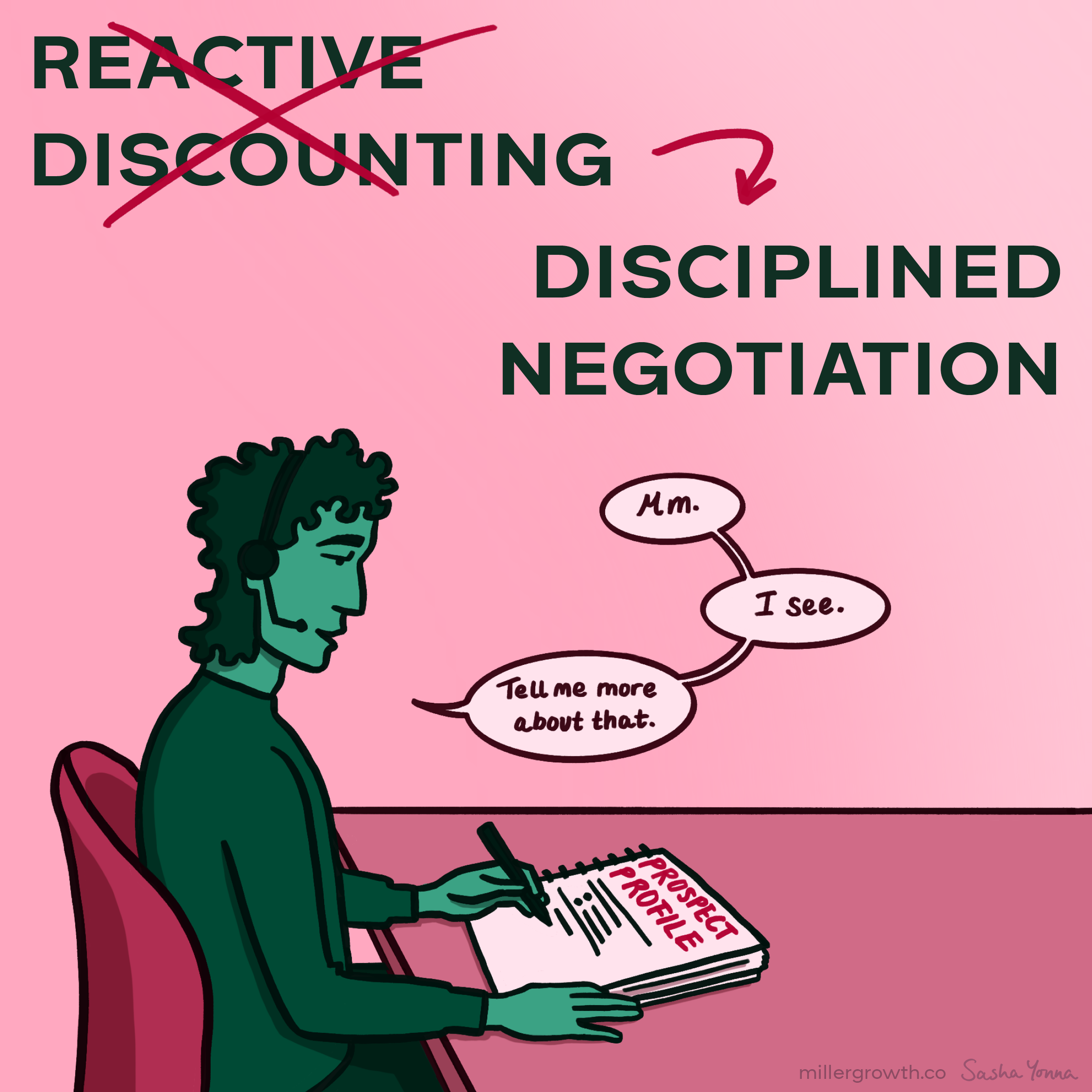
From Reactive Discounting to Disciplined Negotiation at Scale
When price pressure appears, most sales teams default to discounting before they fully understand what the buyer actually needs. This case study shows how agilio restructured negotiation behaviour across a 14-person team - and what changed commercially when they did.

Relevant resources
Tools and insights for improving your revenue engine
Demo Training
Coach winning demos

Discovery Training
Qualify deeper, faster
AE Toolkit
Hire top performers
See more resources →