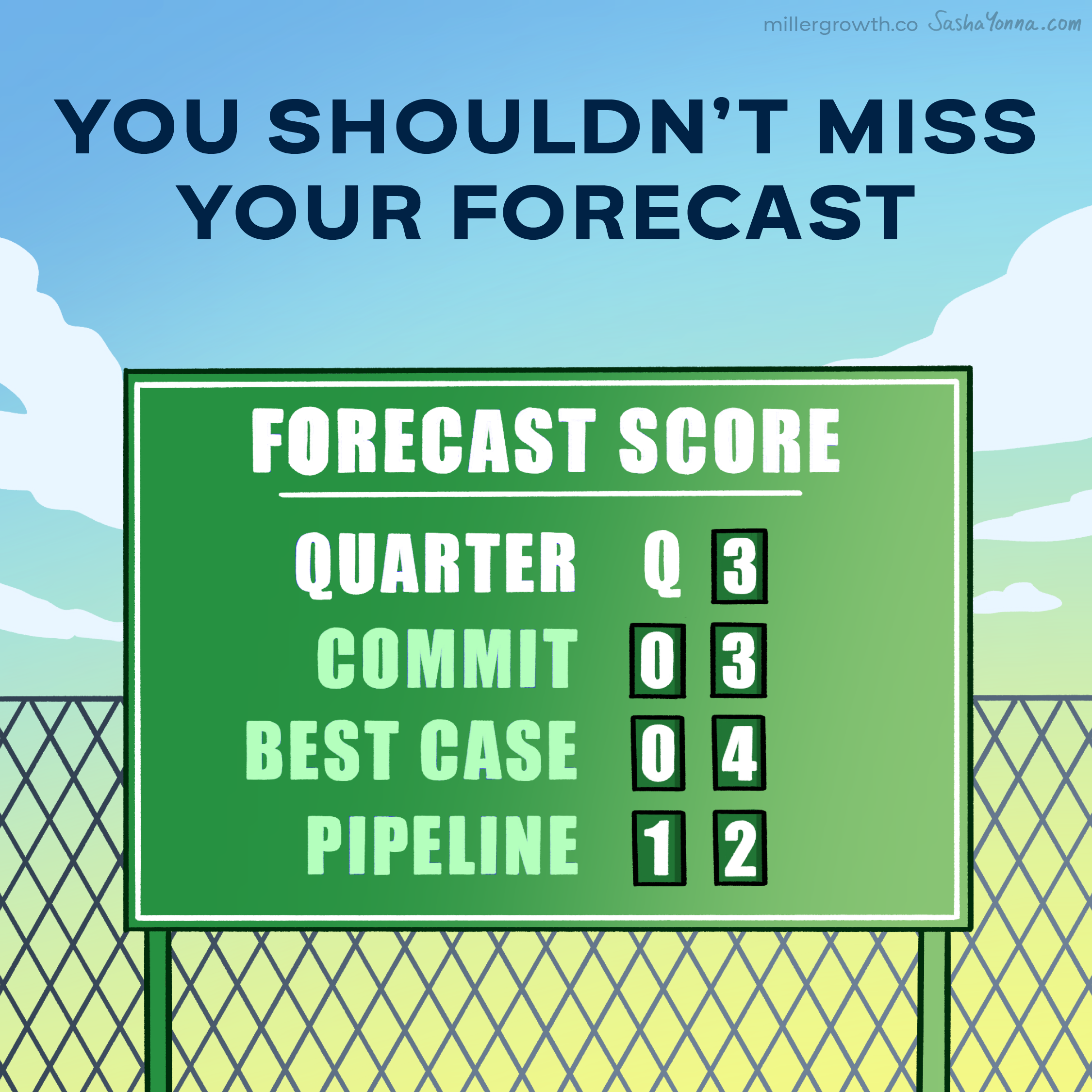
You shouldn't miss your forecast
GTM & Strategy, Pipeline & Deal Velocity
Who is it for?
Sales leaders, CROs, and founders who own revenue forecasting.
When to use?
When forecast accuracy is weak, quarter-end surprises are common, or pipeline reviews lack a shared definition of commit.
2026-10-27
Missing a target is recoverable. Missing a forecast and only realising it in the final days of the quarter is a different problem entirely - it means you don't understand your deals. Here's how to fix that.
Missing your target as an individual or a leader happens from time to time. Provided you're taking the right steps to correct it and maximise your chance of success next quarter, it's rarely a disaster.
If you miss your forecast by a lot but only realise that's going to happen in the last few days of the quarter, that reflects a very poor understanding of the deals. This is unforgivable.
Note the distinction: target is what your business goal is. Forecast is what you are calling based on the evidence you have.
Most forecasts are done in one of two ways, or a combination, both of which are deeply flawed.
1️⃣ An AE roll-up: ask the sellers what they're confident about, include the confident deals, and add in some percentage of the rest.
2️⃣ A weighted forecast based on the pipeline stage and some percentage associated with that stage.
The first goes wrong because sellers are guessing based on emotion. The second goes wrong because the percentages are arbitrary or the pipeline stages are inaccurate.
There are two things that fix this. Ideally, you will do both.
1️⃣ Define what commit means. The critical issue with the AE roll-up is that there's no clear definition of what you mean by "commit". Instead, every AE is making their own guess based on their feelings. Your CRM probably already has forecast categories, you just need to use them rigorously. I recommend three: Commit, Best case, Pipeline. Each with a clear definition:
Commit: we have full visibility into the Paperwork Process that shows a signature this quarter, and we have commitment from our Champion to make this happen, along with support from the Economic Buyer.
Best case: we understand the Decision and Paperwork Processes, which we've mapped out with the Champion, showing that this can close in the current quarter. We have one significant hurdle - XYZ - and a path to resolve it.
Pipeline: anything else where there's an indication that the Decision Process and Paperwork Process can complete this quarter.
Until you have your own numbers, count these as 90%, 50%, and 10%.
2️⃣ Look at the data. If you have any significant volume of data from the last several quarters, look at the pipeline you had, the stage you were at, and where that left you in revenue. The more deals you have - and especially where you've got high volume and lower-value deals - the more reliable this becomes.
For example: over the last four quarters, deals that hit Best case closed 45% of the time, and deals sitting in Pipeline closed 12% of the time. That's not a guess - it's your actual number, and it should replace the placeholder percentages above the moment you have it.
Some key notes to bear in mind:
You must, must, must use these to forecast this quarter only. You may have all the right signals that a deal is definitely going to happen, but only a 10% chance of it signing in the current quarter - in which case it's Pipeline.
Don't wrap big swingers into the same calculation. If you have a $3m target for the quarter and a single $1m deal that meets the Best case definition, don't multiply it by the percentage and fold it into your forecast. Run your forecast metrics on the smaller deals alone, then say clearly that you have $2.2m forecast for the quarter, plus a big swinger with a decent chance of closing that could take you over target. That way, everyone knows the true situation.
I've used MEDDPICC language here. It doesn't matter what you use, as long as it is unequivocal and clearly understood by all of your team.
If you get this right, you won't be surprised in the last week of the quarter.
I'm happy to help anyone who's unexpectedly missed the number.
If this was useful, stay close to the thinking.
Get practical GTM insights and strategic breakdowns in your inbox. Weekly.
Related Posts

Pipeline & Deal Velocity
2026-05-06
Complex enterprise engagements that make the difference.
Proven product, real hospital deployments, strong supplier interest - and a CEO carrying every major commercial conversation alone. This is how MediShout moved from early traction to seven-figure ARR by fixing the commercial execution layer, not the product.
Pipeline & Deal Velocity
2026-04-19
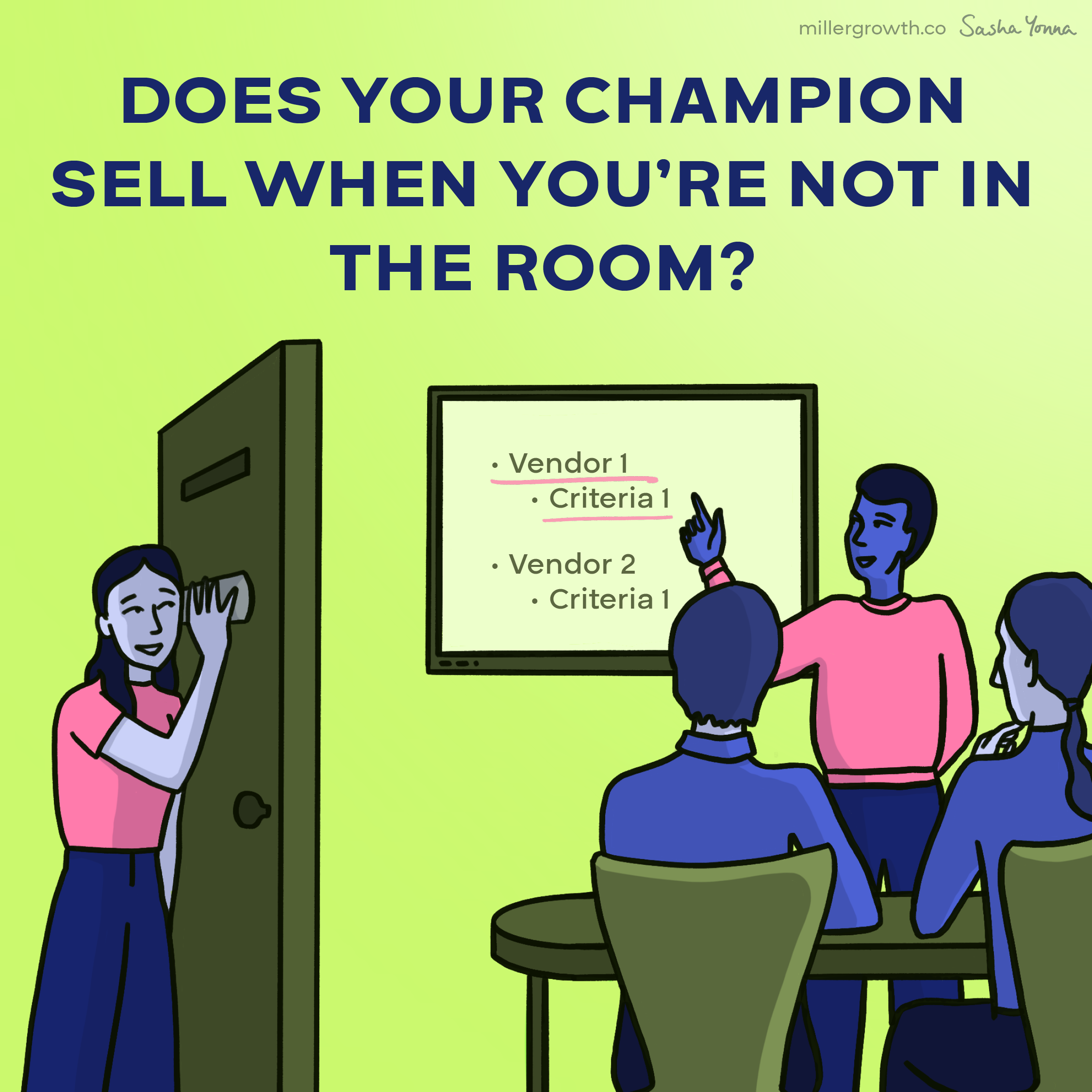
Selling when you're not in the room
In a complex sale, most of the conversations happen without you in the room. What determines the outcome is whether each stakeholder can recall and repeat a simple, specific reason why you're the right choice - and whether you've shaped what that reason is.

Relevant resources
Tools and insights for improving your revenue engine
Demo Training
Coach winning demos

Discovery Training
Qualify deeper, faster
AE Toolkit
Hire top performers
See more resources →