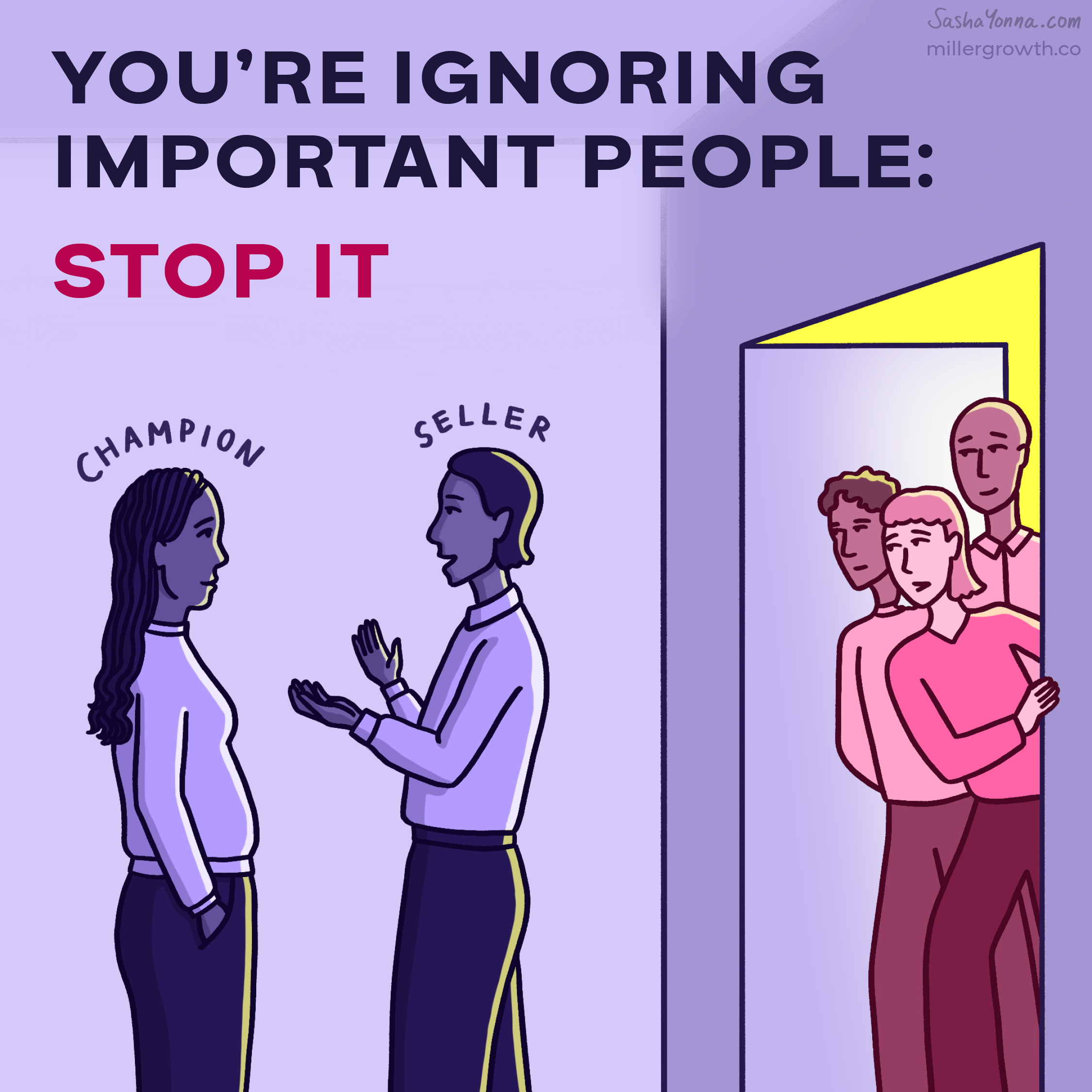
You're ignoring important people - stop it
Pipeline & Deal Velocity
Who is it for?
Account executives and sales leaders running high-value enterprise deals.
When to use?
When a deal is suspiciously single-threaded, but there are clearly other people involved.
2026-08-25
Most sellers in a large deal build one or two relationships and assume the rest don't matter. They're wrong. The people on the periphery hold information - competitor intelligence, internal dynamics, critical feature concerns - that your main contact either won't share or doesn't know.
In any large deal, a handful of people show up to the calls - and most sellers only ever build a relationship with one of them. That's a mistake. Even the people with no influence may hold key information.
All too often, I'm talking through an opportunity with a Seller and discover that several people have been involved in the process - joining calls, asking questions - and we don't understand their roles or their engagement in the evaluation. Or maybe we understand some of that, but we haven't engaged 1-1 and built a direct relationship.
For a $/€/£ 5k deal with 20 people turning up to the demo call, I get it. It doesn't make sense to chase everyone. But for a large deal where a handful of folks turn up, you should engage with all of them.
The normal reasons for not doing so include:
"They don't have any influence on the decision."
"I'm already talking to their boss."
"They only turned up once."
Why they matter
Provided the deal is worth chasing, these people are worth engaging with. You never know who has real influence. You never know which feature or question is the critical one.
And even if they don't have influence, they have information. Which competitor is being preferred? Which feature gap is getting the most air time? Is your main contact on holiday or ignoring you? Maybe you can get a key phone number.
Most people recognise that, with any type of serious enterprise selling, you need to do account mapping to understand:
who the different people are
what their functions are
where the influence lies
how the decision will be made
When you have contacts, you should use them to help you with all of this background information.
How to actually engage
Don't assume that because people are copied on emails, they are paying any attention. Instead, reach out 1-1. Find something from the previous conversation which will be of specific interest to that individual and follow up with them. Ensure you are offering value to them. They will then give you time and information.
If somebody is interested enough to engage with your company, then you should be interested enough to engage with them.
I'm happy to share the account-mapping template I use with clients - just let me know.
If this was useful, stay close to the thinking.
Get practical GTM insights and strategic breakdowns in your inbox. Weekly.
Related Posts


Relevant resources
Tools and insights for improving your revenue engine
Demo Training
Coach winning demos

Discovery Training
Qualify deeper, faster
AE Toolkit
Hire top performers
See more resources →