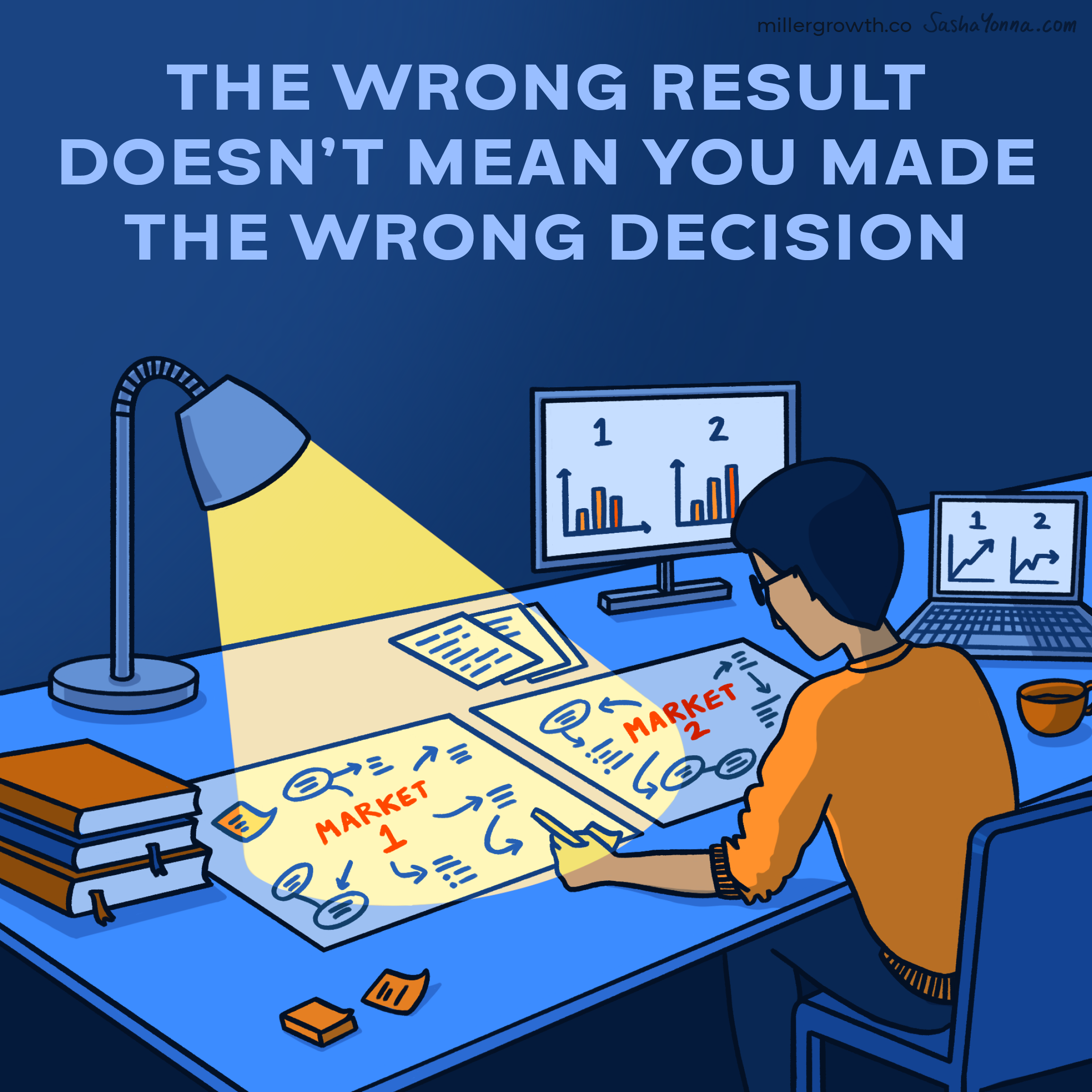
The wrong result doesn't mean you made the wrong decision.
General
Who is it for?
Founders, CEOs, and commercial leaders who make high-stakes calls under uncertainty.
When to use?
When a bet on a territory, product, or hire hasn't paid off and you're trying to work out what went wrong.
2026-09-01
Bad outcomes don't always mean bad decisions - and good outcomes don't always mean good ones. What matters is the quality of your reasoning at the time, and whether you're tracking it well enough to tell the difference.
Equivalently, the right result doesn't mean you made the right decision.
That probably sounds counterintuitive, and perhaps it is. Look up 'Resulting', a term popularised by Annie Duke.
When we consider the results of our decisions, time has passed, new information has come to light, and something has happened. But none of that was available to us when we made the decision.
Should I invest sales effort in this account/territory/product?
Should we develop the set of features that certain customers are asking for?
Should we take a new company investment at this stage?
Should we consider changing out person X?
The consequence of these decisions will not be known for weeks, months, or in some cases years.
If, after several months, you discover that investment in that territory has not led to any meaningful return, you might say it was a bad decision. It may have led to bad results. That doesn't mean it was the wrong decision based on the information you had at the time.
For example, you had several signals that customers in that sector would buy. You had sales resource available that understood that sector. If it was successful, it would have had a transformational impact on part of your business. Sounds like you made a good decision. If it turned out that the customer buying signals were contradictory or poor, could you have seen that at the time? If yes, then indeed it was a bad decision. If no, then the decision was fine.
Track your decisions
When you make a decision, you should be clear on what the inputs are to that decision and write them down. Decide how frequently you're going to review the decision, and see whether those inputs have changed or whether you have new inputs that change your perspective.
You might say: we believe that adjacent product Y will solve a significant problem for our existing customers and lead to a 20% upsell across our base in the next 24 months. We believe this because:
we have heard from N customers facts A, B and C
we have validated that there is no other product today that easily fits this problem
we believe we can deliver something viable and useful within 12 weeks.
Write all of this down. Agree that you're going to review all of the information above every month. When you review, consider what other data points you have learnt - from your own development, from sales conversations, and from customer feedback. Don't be hasty: if you get one contradictory data point from customers a month later, that doesn't mean everything else was wrong, but if over three months you get a significant number of clear objections that you are not solving a real problem, pause.
Life is (partly) a game of chance
All games have an element of luck and an element of skill. Poker has a lot of luck and a small amount of skill - but that skill, consistently applied, gives a lasting edge at the table. Bridge has a fair amount of luck and a fair amount of skill - the right decisions can still lead to the wrong outcomes, but over time the right decisions will win. Chess is largely skill - there are no lucky cards.
In business (and life, though that's not my area of expertise), we have to make decisions, but there is a lot of luck too. Make the best decisions based on the best information you have. Be confident, but review and accept that the luck can work in your favour or against you.
I'm happy to share the simple decision-log I use with clients to make this repeatable - just let me know.
If this was useful, stay close to the thinking.
Get practical GTM insights and strategic breakdowns in your inbox. Weekly.
Related Posts


Relevant resources
Tools and insights for improving your revenue engine
Demo Training
Coach winning demos

Discovery Training
Qualify deeper, faster
AE Toolkit
Hire top performers
See more resources →