The price question isn't a trap
Discovery
Who is it for?
Founders, sales leaders, and AEs selling complex or high-value solutions where price comes up early.
When to use?
When your team is losing deals or stalling conversations because they don't know how to handle early pricing questions with confidence.
2026-10-05
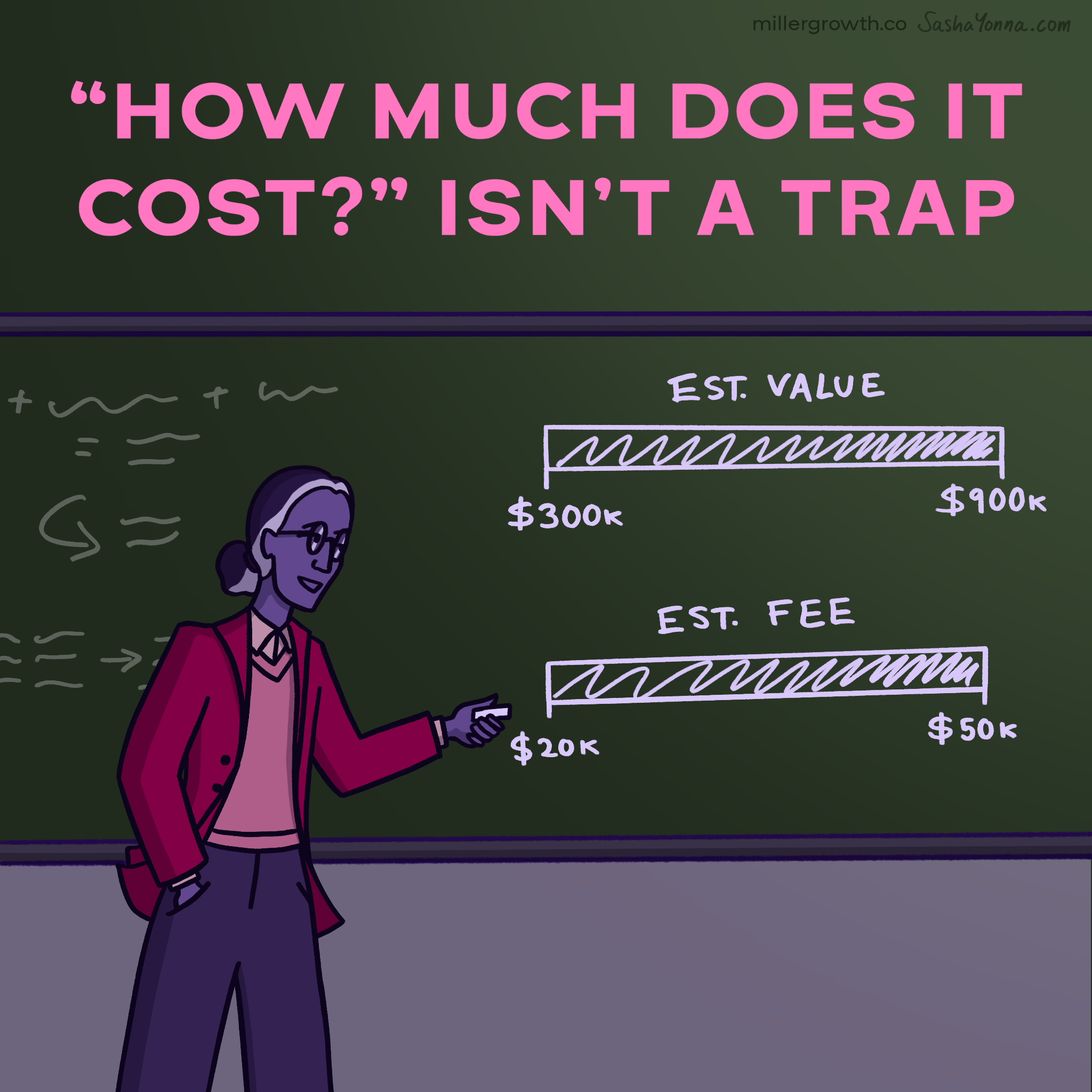
Sellers are often trained to dodge the price question until they've proven value. This can come across as slimy and lose deals. It's better to answer openly, but always provide a value estimate, so the price does not stand on its own.
I'm asked this constantly, by experienced and new sellers: what do you say when prospects ask the price on the first call?
Most sellers do one of two things.
Give a number. This can scare the prospect, especially if it's a new product category whose value isn't well established, and that's the end of your engagement.
Say it all depends on their needs and refuse to give any indication. This sounds evasive and can lead clients to walk away.
There is a clear and sensible approach: give them an indicative range and tie it directly to an estimated value.
When you know how to price the outcome
Some products automate something measurable - processing, error rates, admin hours. You may not know the exact number until you've looked at their data, or run a POC. You can still give a range.
"Given what you've said about your challenges, it sounds quite similar to a couple of clients we've worked with this year. They found they were able to react faster to their customers, make fewer errors, and reduce admin investment - which they estimated at a return of $500k over the year. If we were doing something similar for you, I'd expect the fee to be in the range of $40k to $80k."
The prospect now has a ratio, not a number: whatever the real figure turns out to be, it's roughly six to twelve times the fee. That's what they're actually evaluating.
When you're pricing a process, not an outcome
A consultancy engagement often can't promise a dollar return up front - the value is the answer you'll deliver, not a saving you can quantify yet. Give the shape of the work instead.
"Given our discussion so far, I think there are probably three paths we could take. A short project to understand the deeper problem. A longer process to evaluate the options available to you. A full analysis across your whole domain, with clear recommendations. Depending which of those we go for, you'd probably be budgeting somewhere between $10k at the low end and $70-80k at the top."
When the ROI isn't led by dollars
When you are freeing up capacity or removing frustration, it's often an emotional purchase which is subsequently supported by hard ROI. Don't hesitate to lean into this.
"It sounds like a significant amount of engineering time is going into this, time that isn't helping you ship faster or better. That's frustrating for your engineers and for you. If we gave your team back three or four hours a week each, that would change what they're able to get through - and change how they feel about the work. Across your entire organization, you'd be looking at a price of around $150k."
Each of these will generate a reaction which will help inform your next steps. You are not giving away anything, not making a promise, but you are telling them there is real value, which you will work to define with them.
I'm happy to work through this for your product - just let me know.
If this was useful, stay close to the thinking.
Get practical GTM insights and strategic breakdowns in your inbox. Weekly.
Related Posts
Discovery, GTM & Strategy
2026-06-15
When Enterprise should be your first sales targets
The conventional path - start small, earn logos, build credibility, then go enterprise - is right for most companies. But for some it's exactly wrong. Under the right conditions, a startup can close a tier 1 deal faster than a mid-market one.

Discovery

Relevant resources
Tools and insights for improving your revenue engine
Demo Training
Coach winning demos

Discovery Training
Qualify deeper, faster
AE Toolkit
Hire top performers
See more resources →