The ONLY good response to EVERY question…

General
Who is it for?
For founders and revenue leaders shaping pricing and packaging.
When to use?
Use when you need a fast, practical reset on how you’re approaching the problem.
20 Jan 2025
Composure under pressure is trainable. This post presents a response framework that keeps conversations moving.
During the sales process, your prospects ask questions. On any number of topics. The features you provide. The nature of your support. Whether you can change part of the pricing. Product performance. And quite often they ask questions without actually asking questions: if they redline/update a Statement of Work, or the contract, they are effectively asking questions.
Sometimes you might have an easy answer. Yes, we have that feature. Yes, we can provide support that way. Yes, performance meets those criteria. Yes, I can accept that change. Sometimes you have to say no. Sometimes you don’t know and have to go check. Or maybe you have options.
Regardless of the question or of your position, THERE IS ONLY ONE CORRECT RESPONSE, and it is true in nearly every single possible situation. Any guesses?
“Could you let me know why that is important to you?”
Ultimately, the customer has a reason for asking the question. Maybe they’ve just realised that their project relies on a certain functionality they have not discussed with you. Maybe your competition has planted a landmine to trip you up (mixed metaphor aleart!). Maybe the CFO is imposing some regulations. Maybe they’re just curious.
Without knowing why they are asking, you can’t answer helpfully. There are many ways of responding, all of which are similar to my suggestion above.
* “Sounds like you have been burnt with an issue around support response times?”
* “Could you explain the use case for that feature in your business?”
* “My guess is there is something behind that question, can you give me a little more background?”
And then be quiet and listen to their response.
Once you know the reason, your follow-up will be much more applicable.
* “Ah, you’re trying to achieve X. Yes, the feature you described would achieve that, but there is an easier way…”
* “I can always ask about a discount, but we have more flexibility on payment timing.”
* “It sounds like that performance goal is considerably higher than you need in order to deliver an excellent user experience; and we can further enhance the user experience by…”
This way, you don’t get caught in landmines. You don’t spend time investigating how to deliver a feature that is only of passing interest. You don’t spend time defending your performance when it’s more than adequate.
Always, always ask why-are-you-asking?
If this was useful, stay close to the thinking.
Get practical GTM insights and strategic breakdowns in your inbox. Weekly.
Related Posts
General
2026-03-30
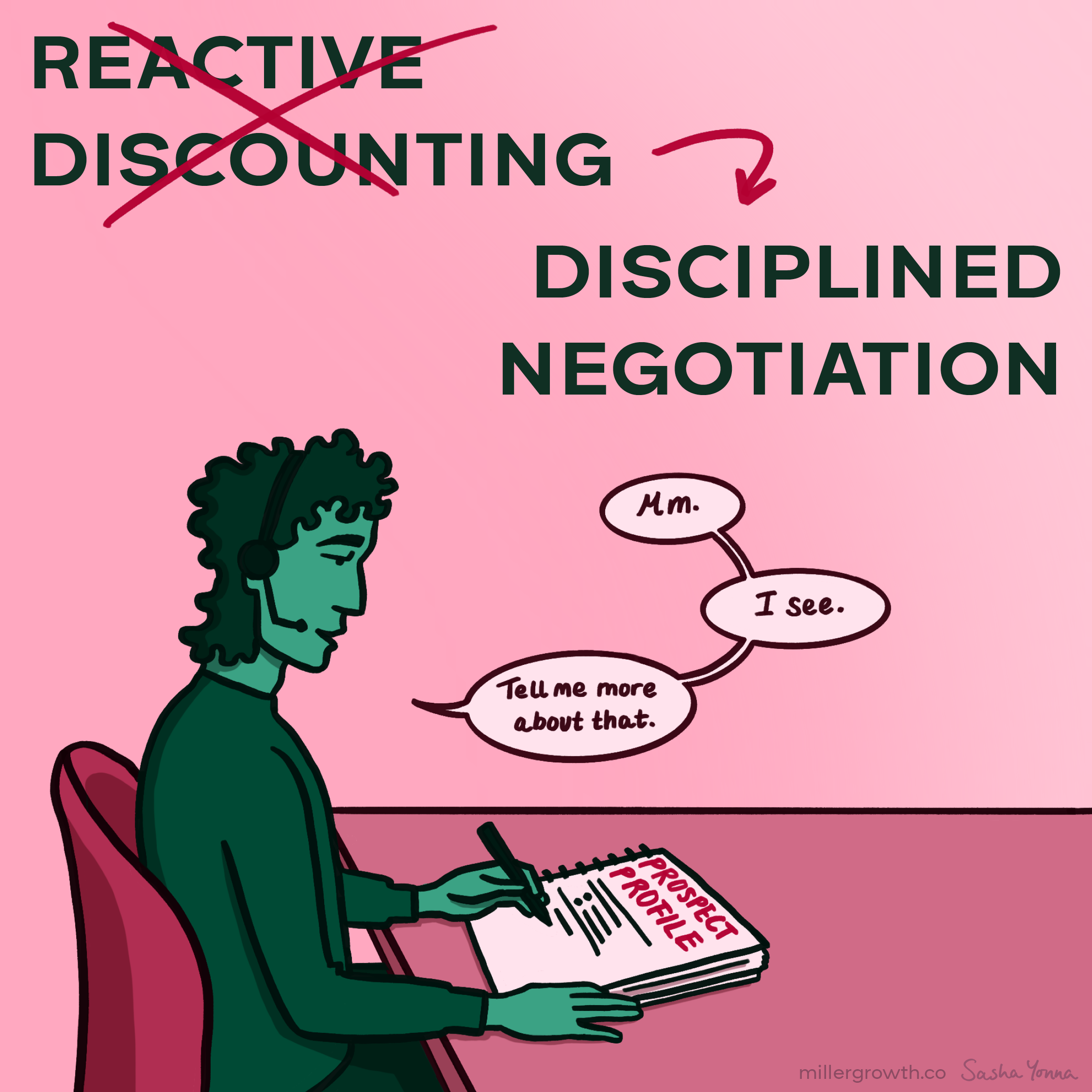
From Reactive Discounting to Disciplined Negotiation at Scale
When price pressure appears, most sales teams default to discounting before they fully understand what the buyer actually needs. This case study shows how agilio restructured negotiation behaviour across a 14-person team - and what changed commercially when they did.

Relevant resources
Tools and insights for improving your revenue engine
Demo Training
Coach winning demos

Discovery Training
Qualify deeper, faster
AE Toolkit
Hire top performers
See more resources →