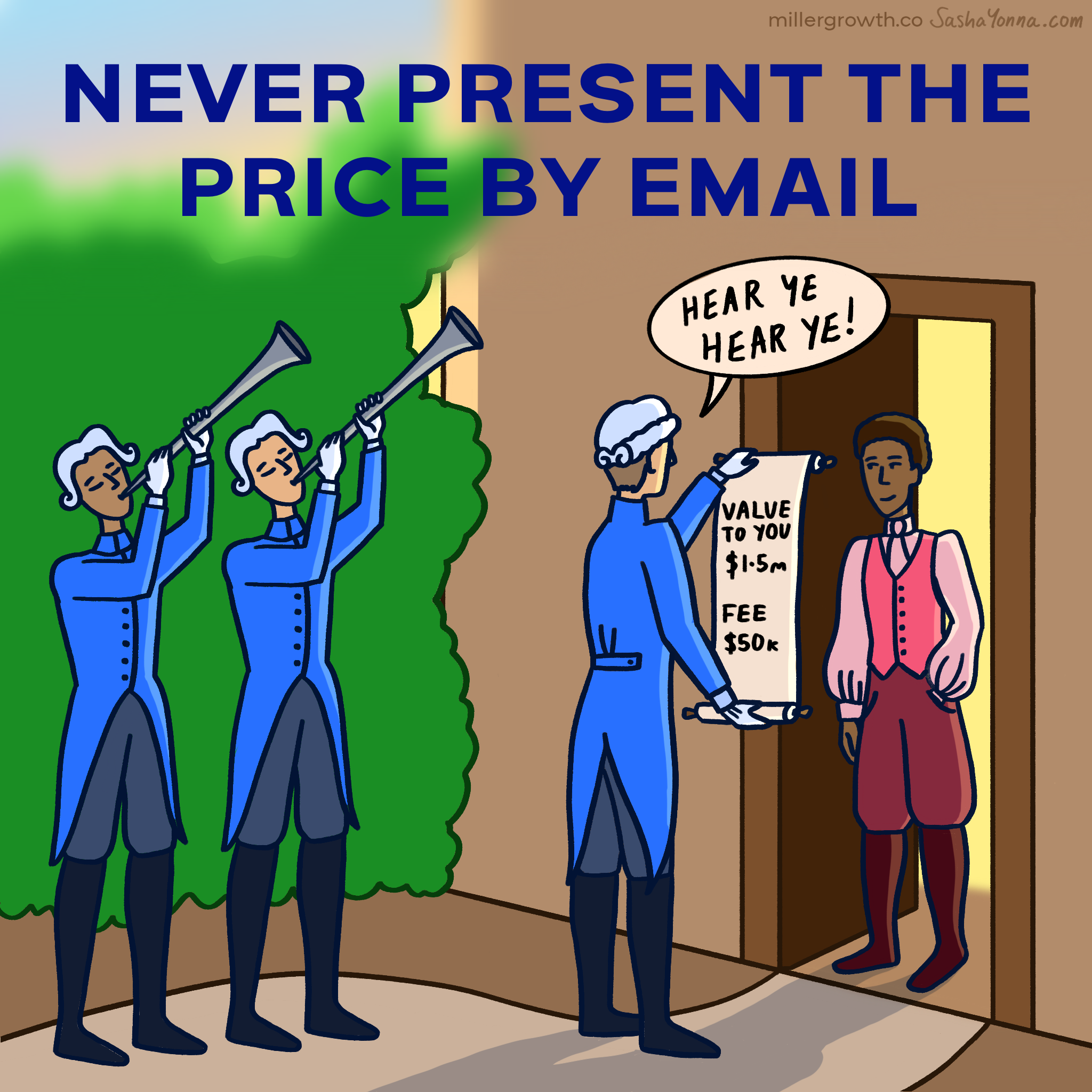
Never present a price by email
Pipeline & Deal Velocity
Who is it for?
Sales leaders, CROs, and founders closing mid-market or enterprise deals.
When to use?
When a proposal has gone quiet, or procurement is pushing back on price despite an existing discount.
2026-10-12
An excited prospect goes quiet the moment you send the proposal. A discount you've already given gets squeezed by procurement anyway. In both cases, it's about providing a price without the supporting information.
I'm often talking with sellers who are bemoaning one of two things.
"I sent a proposal, and I've heard nothing since. They seemed really excited when I first spoke to them. What's going on?"
"We've just been sent to procurement, and now they're pushing us for a reduction - but we've already given a big discount."
Behind these are the same mistake: pricing provided in isolation without the relevant context.
Follow these three rules religiously.
1️⃣ Same page
Price is never on its own but always next to the value. Slide 1 reminds them of the problem. Slide 2 reminds them of the cost of that problem. Slide 3 shows them that cost next to the price you'll charge to fix it.
This is usually what's behind the excited call that goes quiet. The enthusiasm was real on the call - then the proposal arrived a week later with the number sitting on its own slide, nowhere near the reason it made sense.
2️⃣ Show the discount from day one
If you're including any discount, make it visible from your very earliest conversations, and keep it visible everywhere the price appears afterwards.
It's incredibly difficult to tell procurement, after the fact, "Oh yes, we already discounted 25% from list price." They don't take your word for it. They take what's on the page - and if the page never showed a discount, there's no reason for them to believe one is already priced in. That's the seller from the second complaint: not being squeezed because the price was too high, but because nothing on paper proved it had already moved.
3️⃣ Present it live
The first time you show a price, do it in real time - face to face if that's realistic, video call otherwise, audio at the very worst. You get to watch the reaction as it happens, and to put the value next to the cost yourself rather than leaving a reader to do it alone. If you've mis-scoped something, you find out immediately and can correct it before sending it in writing.
This is written for mid-market or enterprise deals that take multiple engagements to close. If you're running high-volume, low-value opportunities, email might be the right way to deliver the price, but (1) they should already have heard the number on a call, or seen it on your site, and (2) you should always include the value statement next to the price.
Both complaints trace back to the same gap. Keep the price and the reason for it next to one another.
I'm happy to look at a proposal that's gone quiet, or talk through how you're showing a discount - just let me know.
If this was useful, stay close to the thinking.
Get practical GTM insights and strategic breakdowns in your inbox. Weekly.
Related Posts


Relevant resources
Tools and insights for improving your revenue engine
Demo Training
Coach winning demos

Discovery Training
Qualify deeper, faster
AE Toolkit
Hire top performers
See more resources →