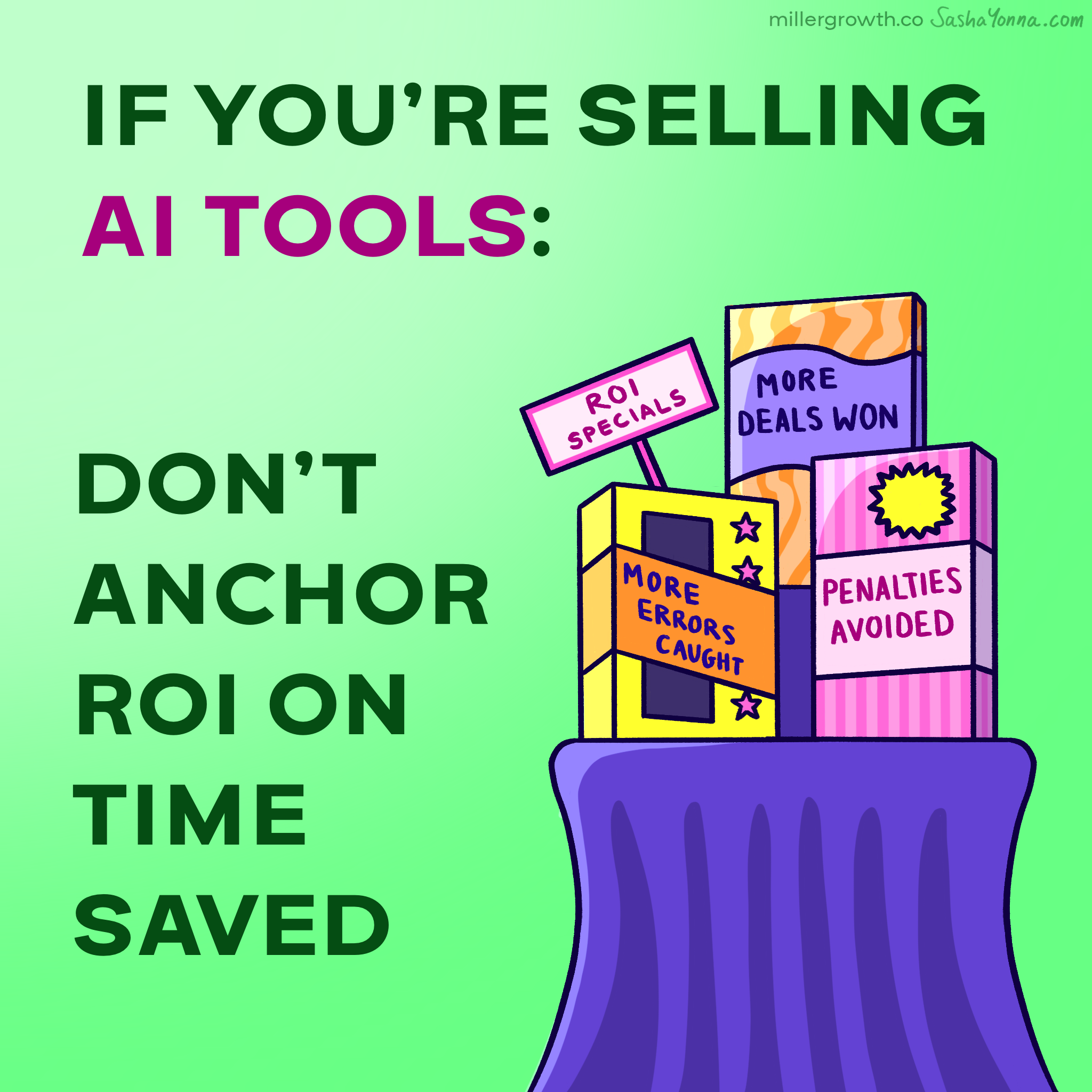
If you're selling AI tools, don't anchor ROI on time saved.
Discovery, GTM & Strategy
Who is it for?
Founders and sales leaders selling AI products with an admin or automation use case.
When to use?
When your current ROI narrative isn't converting late-stage deals or is stalling at budget approval.
2026-10-20
Adding up the hours saved gives you a number too small to excite a buyer, or one so large it frightens them. Build the ROI on the errors caught, penalties avoided and deals won instead.
I've been working with several companies whose AI products take a large amount of admin off their customers, and they all reach for the same ROI - hours saved. It's easy to calculate and easy to explain.
The trouble is that it fails in two (opposite) ways.
1️⃣ The number is often too small. Four fewer admin staff is a $200k saving. Is that exciting enough to win time and attention when the buyer has so many other projects to choose from?
2️⃣ When the number is big, it's threatening. Companies don't like the idea that they are about to fire a group of staff. More likely, they will repurpose them. And where the numbers are high, in many countries there will be legal and union-based reasons why headcount reduction is not an attractive basis for an ROI case.
Real value
Find the real value behind what you do:
If you process invoices and manage payments, the value is in the errors caught and the invoices deferred.
If you manage contracts and give visibility into commitments, responsibilities and penalties, the value is in the penalties avoided, or imposed on the supplier.
If you manage an operations inbox that receives many inbound quote requests, the value is in prompt responses and therefore a higher win rate.
These outcomes are more attractive to the buyer, both financially and emotionally.
Build the justification
Discovery has to find where they already know they have errors or issues. Speak to team members, team leads and executives, not just one person. Each will have a different view of the challenges they've faced and the mistakes they've made.
Often the buyer has no idea they are leaking money. Include an analysis of their last three months' data in your sales process, and show them where an invoice was incorrectly stated, where a penalty could have been avoided, or where orders could have been won.
Your existing customers are another source of evidence. Ask why they like your product and I suspect few of them will talk about time saved. They will talk about accuracy and revenue opportunities, and that tells you what to look for in your next prospect.
The headcount case
If your business case does rest only on the volume of admin work avoided, present it carefully.
🚫 Avoid: "You will save 50 heads over the year, and therefore about $2.5m in employee costs."
✅ Better: "You will have 50 additional admin team members who can address the projects that matter most to the business." (Ideally, you will have helped identify those priority projects during discovery.)
📈 Or, if the business is growing fast: "Rather than adding another 50 people next year, you can absorb that growth with the team you have."
Start with what the buyer is losing today, and build the ROI around that. I'm happy to share the discovery questions I use to find where a prospect is leaking money - just let me know.
If this was useful, stay close to the thinking.
Get practical GTM insights and strategic breakdowns in your inbox. Weekly.
Related Posts


Relevant resources
Tools and insights for improving your revenue engine
Demo Training
Coach winning demos

Discovery Training
Qualify deeper, faster
AE Toolkit
Hire top performers
See more resources →