How long is the Founder in sales?

Leadership
Who is it for?
For sales leaders and founders hiring or developing revenue talent.
When to use?
Use when interviews produce false positives and you need a repeatable way to assess real capability.
12 May 2025
Founder-led sales cycles often stretch invisibly. This piece explores how long founder dependency should persist.
In every new company, one of the founders leads the sales activity. Everything from lead generation, through opportunity development and to closure. Often, they’re very good at it. Founders with deep understanding of their business and industry, and incredible passion for the problem they are solving, are uniquely able to get those first deals done.
Most often, this is the CEO, and they have a bunch of other things they need to do – like run the business. Therefore, at some point there must be change.
In well-established companies, the CEO has an important role in sales. They will engage with the largest clients; they can be part of senior outreach for pipeline generation; major deals will involve CEO conversations. A common model is that the CEO spends
👉 33% of their time managing the company
👉 33% managing investors
👉 33% on sales.
If this is the case with established companies, it’s even more so with start-ups.
It is never right to hire a sales leader and expect them just to make a happen. However, it is right to expect that your sales team will take on more and more of the heavy lifting. There are a series of phases to go through.
1️⃣ Work closely with the earliest sales hires in every deal, developing the repeatable sales process with them, gradually stepping back so they can drive. Good sales professionals will help the founder understand the process better, and use the founder as needed.
2️⃣ Once you have a sales team that has demonstrated they know how to run the sales – maybe a couple of really good sellers reporting to the founder, or a small team reporting to a head of sales – the founder continues to be involved in all substantial deals, in two roles.
* The first is as a super SE. (SE = sales engineer / solution engineer, sometimes known as solution architect. The more technical side of the sale.) The founder understands the solution and the problem space more deeply than anyone else. They can articulate how it will solve the problem most effectively and how it will integrate into the prospect’s environment.
* Secondly, they are the main executive sponsor. They should be directly engaging with the C-level at the prospect, reaching out and building relationships and giving confidence in the business.
3️⃣ As the sales team grows and becomes increasingly competent, and there are more deals than the founder can reasonably engage in, they continue to perform the two roles above, but in fewer cases. For key deals they are the exec sponsor. They may also be the super SE, but with a slightly different role. Rather than discussing integration details, they may be presenting key industry information to a particular CxO persona.
This final phase may well be indefinite.
If this was useful, stay close to the thinking.
Get practical GTM insights and strategic breakdowns in your inbox. Weekly.
Related Posts
Leadership
2026-06-22
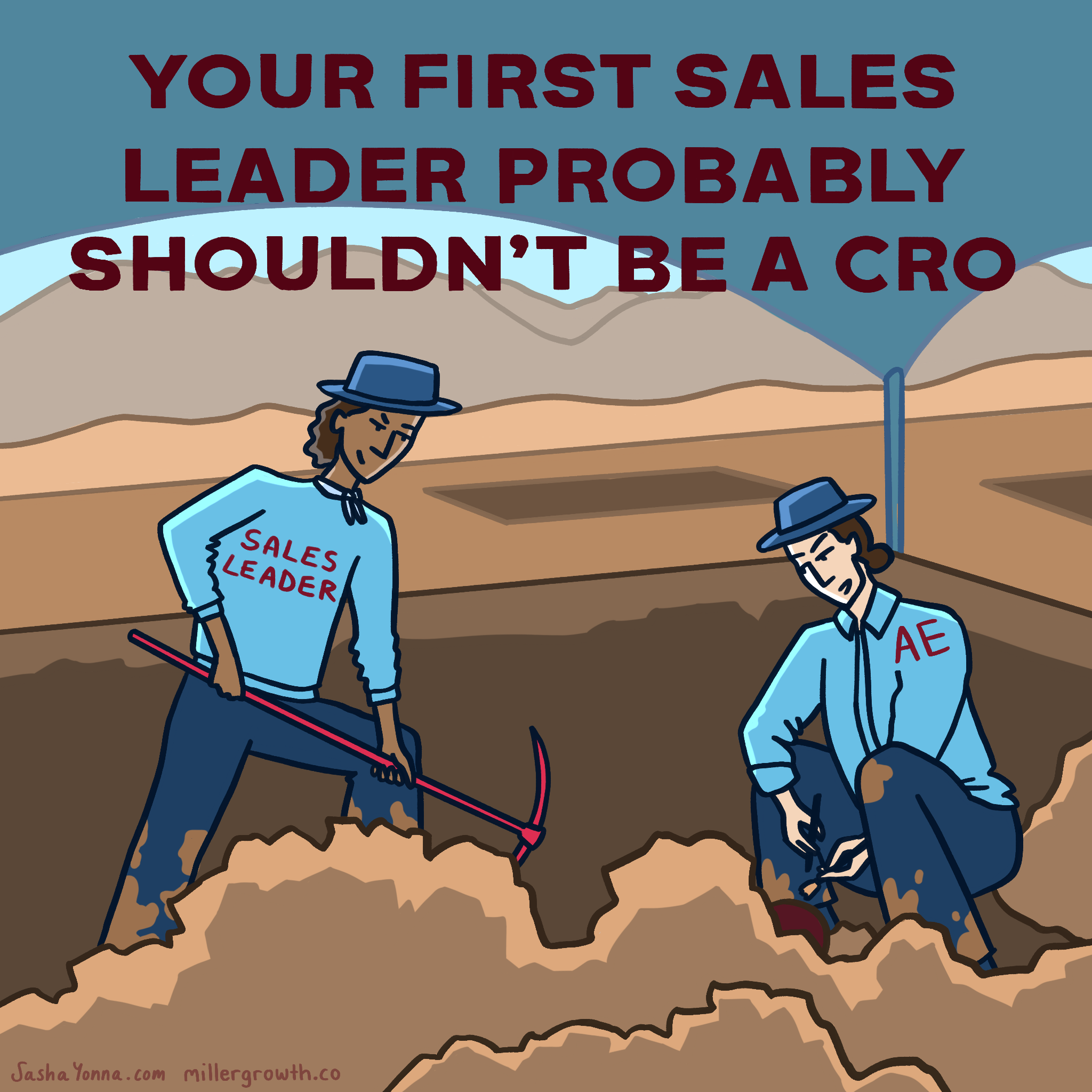
Your first sales leader probably shouldn’t be a CRO
Hiring a CRO too early is one of the most common and costly mistakes in early-stage commercial hiring. Your first sales leader needs to be on live deals, not building org charts - the job is to make founder-led selling repeatable before you scale anything.
Leadership, Pipeline & Deal Velocity
2026-06-08
Case study: Driving Consistency and Commercial Impact at Geobear
Geobear had strong inbound demand and real revenue - but inconsistent sales execution was costing them deals they should have won. This case study covers how a nine-month engagement rebuilt their sales motion across four regions, from discovery and quote delivery to follow-up discipline and manager coaching.
Leadership, Pipeline & Deal Velocity
Relevant resources
Tools and insights for improving your revenue engine
Demo Training
Coach winning demos

Discovery Training
Qualify deeper, faster
AE Toolkit
Hire top performers
See more resources →