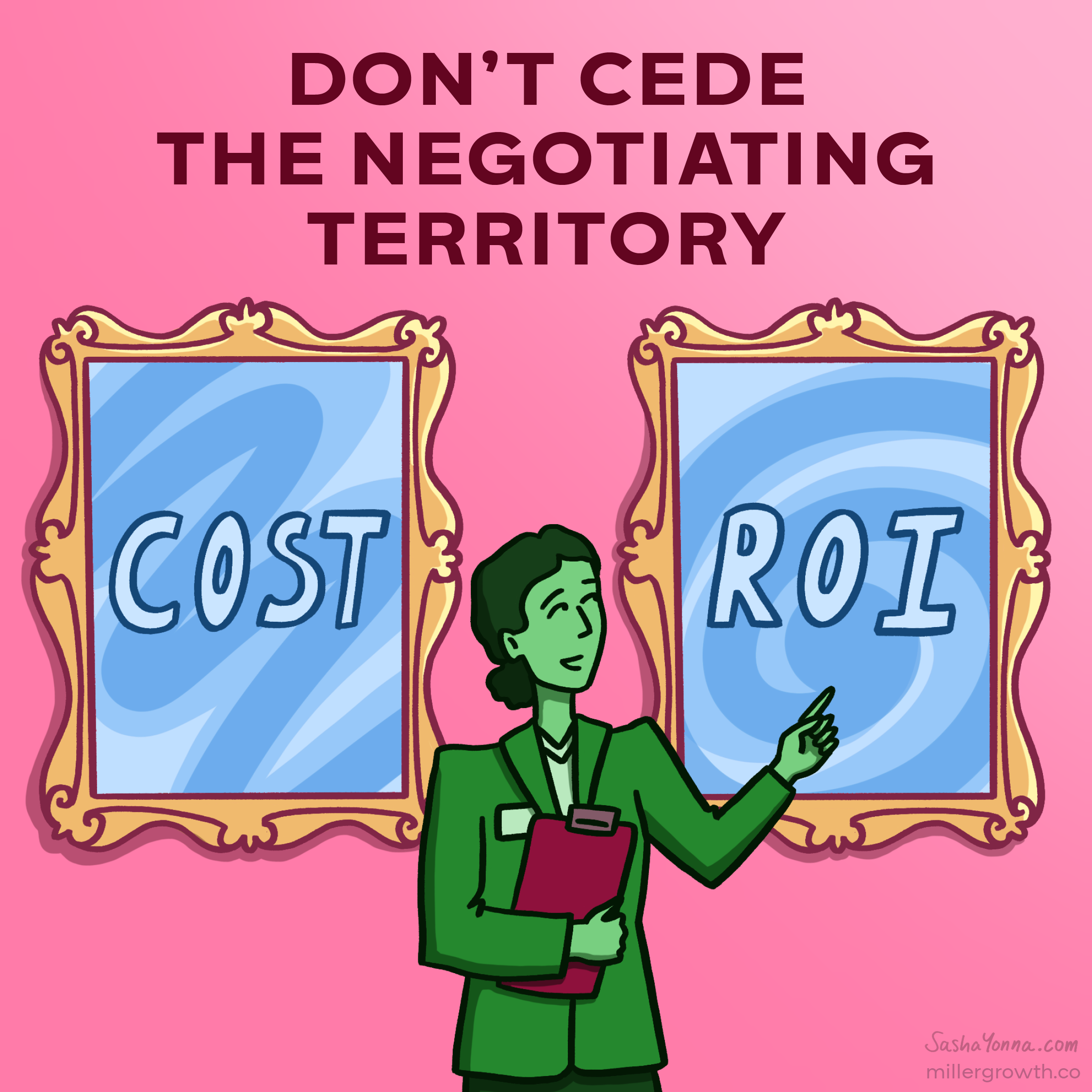
Don't cede the negotiating territory
Pipeline & Deal Velocity
Who is it for?
Founders, CROs, and senior sales leaders managing high-value or stalled deals.
When to use?
A buyer is reframing the deal on price or structural terms before you've diagnosed what's actually driving it.
2026-11-16
Buyers rarely know how to evaluate what you're selling. But they are very good indeed at beating vendors down. When they frame a negotiation on their own terms, the instinct is to fight the battle as they frame it - but that's exactly how you lose.
I've supported two client negotiations recently that had the same challenge.
In the first, the prospect refused to attribute any value to the return on investment, even though the POC had proven it at 5-10x. He was focused on cost alone, and every time ROI came up he shut the conversation down.
In the second, the buyer kept saying they didn't want a recurring fee. They wouldn't engage with how or why that was a problem. It was simply a fact to be worked around.
In both cases, my clients' natural reaction was to work out how to win the battle as framed by the prospect.
"He's comparing us with XYZCompetition who can't really deliver the same results, but they're one-third of the price. Therefore, we can position ..."
"Maybe we can provide a large upfront one-off fee with a significant recurring maintenance fee in order to address their concerns."
Yuk.
The first response accepts that price is the axis. Once you're arguing about the size of the gap, you've agreed to have the argument on their ground, and the only moves left are discounts.
The second treats "no recurring fee" as a requirement rather than a symptom. What's driving this? It might be a budget cycle, a procurement rule, COGS concern, or a bad experience with a vendor three years ago. Restructuring the deal before you know which one it is means solving a problem you haven't diagnosed.
Our goal, as MEDDPICC helpfully directs, is to find their pain, understand the value of it, show how we uniquely solve it, and set a price that reflects that value.
Cede the negotiating territory and all of that work is wasted.
They know how to buy. They don't know how to buy this.
I've written before that buyers often need our direction to define their Decision Criteria and Decision Process. They rarely buy the type of product you sell, so they don't know how to evaluate it.
But they buy all sorts of other things, and they have a well-worn path for beating vendors down. Keep that asymmetry in mind. You are engaged with amateurs at evaluation and professionals at squeezing, in the same room, often in the same person.
Do not get led astray.
Four rules for holding your ground
1️⃣ Keep saying it. Just because they don't like your position doesn't mean you stop stating it. Their discomfort is not an instruction. If the ROI is 5-10x, that remains true however many times the conversation gets shut down, and it needs to be on the table every time.
2️⃣ Ask what's behind the demand. The recurring-fee buyer never explained themselves, and my client hadn’t asked. So ask! "What’s driving that?" You cannot solve a requirement you haven't diagnosed.
3️⃣ Remember there is more than one person involved. Even if procurement is banging one particular drum, check what instruments your Champion and Economic Buyer prefer. The person squeezing you hardest is rarely the person who wants the outcome most.
4️⃣ Crucially, understand what their alternative is. If it's one-third of the price and delivers a tenth of the value, stand your ground. If you don't know what their alternative is, you aren't negotiating - you're guessing.
You are not going to talk a buyer out of wanting to pay less. But you can build enough unique value such that their alternative is visibly worse, and then hold the ground you built while they bluster.
I'm happy to talk through a live negotiation, or to share the questions I use to work out what a buyer's real alternative is - just let me know.
If this was useful, stay close to the thinking.
Get practical GTM insights and strategic breakdowns in your inbox. Weekly.
Related Posts

Discovery, Pipeline & Deal Velocity

Leadership, Pipeline & Deal Velocity
2026-06-08
Case study: Driving Consistency and Commercial Impact at Geobear
Geobear had strong inbound demand and real revenue - but inconsistent sales execution was costing them deals they should have won. This case study covers how a nine-month engagement rebuilt their sales motion across four regions, from discovery and quote delivery to follow-up discipline and manager coaching.

Leadership, Pipeline & Deal Velocity
Relevant resources
Tools and insights for improving your revenue engine
Demo Training
Coach winning demos

Discovery Training
Qualify deeper, faster
AE Toolkit
Hire top performers
See more resources →