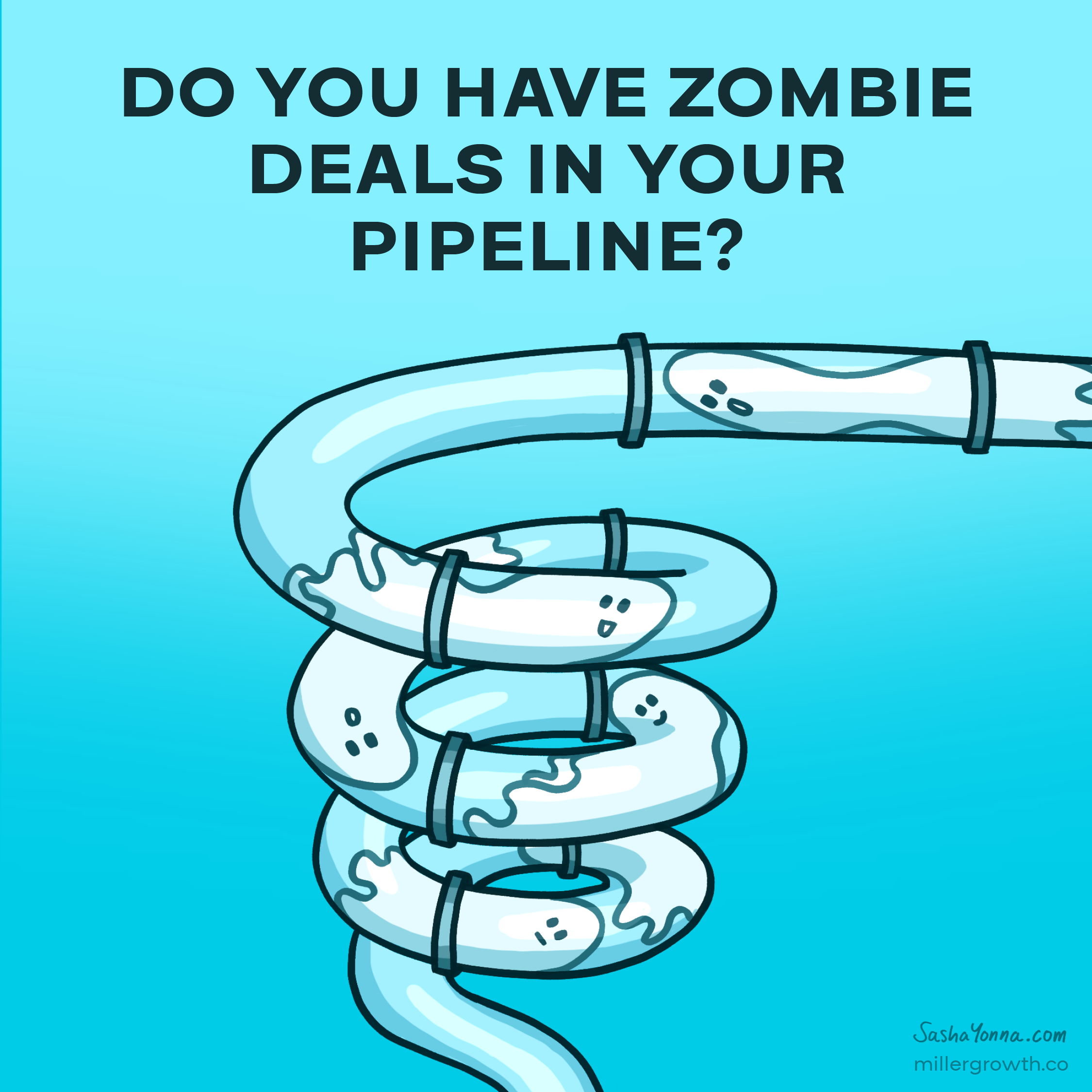
Do you have zombie deals in your pipeline?
Pipeline & Deal Velocity
Who is it for?
Revenue leaders, AEs, and CEOs who own forecast accuracy.
When to use?
When pipeline coverage looks strong but quarters keep coming in short.
2026-05-10
Deals don't always die cleanly - they linger. When close dates keep slipping and champions go quiet, most pipelines are carrying losses that haven't been called yet. That distorts forecasts, wastes selling time, and masks the real coverage problem.
“Lost deals take 2.0x longer to close than won deals”. That's from the excellent Fullcast_Pavillion-2026-GTM-Benchmark Report.pdf. According to the data, it takes 225 days on average for deals to be lost and only 115 to win them.
There's a slightly hidden reason for this: deals stay in the pipeline well beyond the point they're already lost. The seller, or the seller's manager, is holding out hope.
Almost always, it's one of these four:
There was never really a project, just some interest from some techies.
There was a project, but its priority has dropped and it's been bumped out six months.
There's a strong competitor who's leading the race, and we're hoping for a look in at the last minute.
We're just not getting much response from anyone.
In each case, the deal is lost. But we let it sit around for weeks, sometimes months, waiting for it to come back to life.
These are zombie deals. Walking dead. And almost as dangerous.
Missed forecasts
When you have zombie deals in the pipeline, they create noise and confusion.
"Hey," says the CEO, "looks like we've got 4.2x coverage this quarter." The board and CFO feel warm and fuzzy. But really, you've only got 2.7x coverage, and the CEO is going to be very, very frustrated with the revenue leader when you miss the quarter by 20%.
The revenue leader is calling a higher number than the real one. AEs with phantom deals are assuming some of them close, which means they're also over-forecasting. The error compounds at every level.
You might be smart enough to flag these in the CRM as unforecasted. That helps, but now you're spending extra time managing the CRM, and there will always be somebody who doesn't understand the in and outs of your categorisations.
Wasted time
The bigger cost is what you're not doing.
Sellers, managers, and everyone supporting them are pouring hours into calls, emails, and pipeline reviews on these deals. We're sending information. We're catching up over coffee. Of course we should retain contact and relationships, but at a fraction of the intensity of a deal you're actually trying to win.
Meanwhile, real deals are getting less attention than they deserve, and pipeline isn't being built.
Don't let "I don't have much else in the pipeline, so I might as well push for this" sway you. Twenty hours a week free to build pipeline is worth far more than twenty hours spent on lost causes.
Why we hold on
Sunk cost fallacy. We've put in the effort, so giving up feels like waste. There's loss aversion in there too: marking deals lost feels like losing something we already had, even though we never had it.
Both are illusions. No amount of additional investment is going to change a lost deal. You're throwing good time after bad.
How to spot one
You don't need a perfect rule. A few practical markers, any one of which should make you suspicious:
You have never had access to the economic buyer.
You don't have any meaningful edge over the competitive alternative.
Your champion has gone quiet for longer than usual.
You can't name the next concrete step, with a name and a date.
The close date has slipped multiple times.
Any of those, and the deal probably belongs in the lost column.
Kill those deals. See your pipeline as it actually is. Then go and build a real one.
Happy to talk through specific deals or pipeline reviews if any of this is live for you right now
If this was useful, stay close to the thinking.
Get practical GTM insights and strategic breakdowns in your inbox. Weekly.
Related Posts

Pipeline & Deal Velocity
Relevant resources
Tools and insights for improving your revenue engine
Demo Training
Coach winning demos

Discovery Training
Qualify deeper, faster
AE Toolkit
Hire top performers
See more resources →